


Tax-Efficient Retirement Withdrawals in Canada
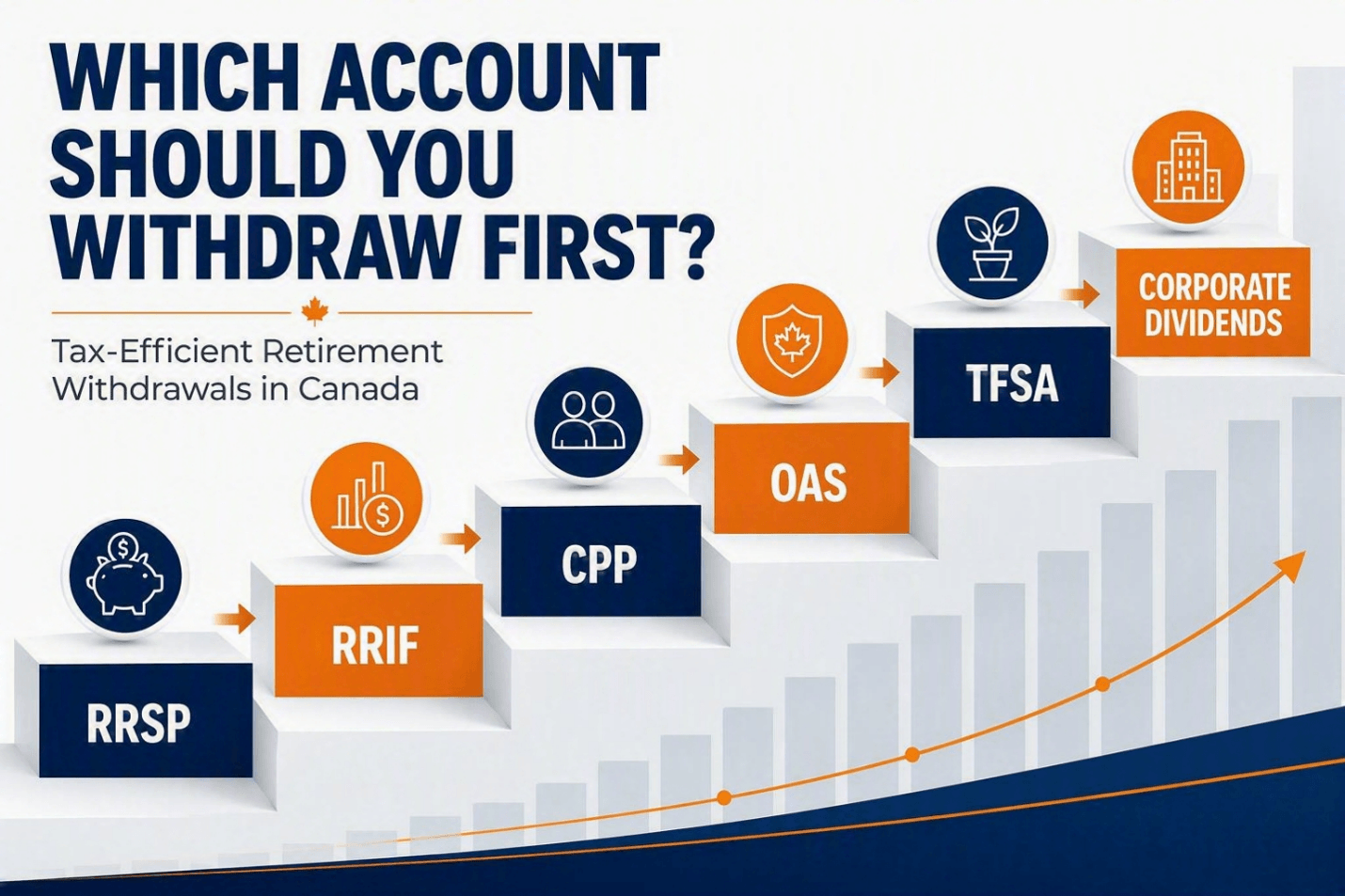
(Caption: One Example of a Tax-Efficient Withdrawal Strategy)
Most people spend decades focused on accumulating retirement assets. Very few spend equivalent time thinking about how to draw those assets down efficiently. That is a mistake, because the sequence and source of your retirement withdrawals can have just as much impact on your lifetime wealth as the returns you earned getting there.
This is especially true for incorporated professionals and business owners who have multiple pools of assets: RRSP and RRIF, TFSA, corporate retained earnings, non-registered investments, and eventually CPP and OAS. Getting the sequence right can save tens of thousands of dollars in tax over a 20- to 30-year retirement.
Why Sequence Matters:
Retirement planning is not just about how much you accumulate. It is also about where your retirement income comes from and when you withdraw it.
In Canada, your tax rate in retirement is not fixed. It is determined by how much income you report in any given year. Every dollar you withdraw from an RRSP or RRIF is added to your taxable income. So is every dollar of eligible dividends you take from your corporation. So is CPP. So is OAS, until you hit the clawback threshold. The OAS recovery tax threshold changes annually and is indexed to inflation. For the current threshold, refer to CRA or Service Canada guidance.
TFSA withdrawals generate zero taxable income and have no impact on income-tested benefits. They are invisible to the CRA from an income perspective.
The goal is to manage your taxable income each year to stay in the lowest possible tax bracket, avoid or minimize the OAS clawback, and maximize lifetime withdrawals at the lowest possible effective tax rate.
An Example Withdrawal Sequence:
| Asset Source | Taxable? | Affects OAS? |
|---|---|---|
| RRSP / RRIF | Yes | Yes |
| CPP | Yes | Yes |
| OAS | Yes | Yes |
| Corporate Dividends | Yes | Yes |
| TFSA | No | No |
| Non-Registered Capital Gains | Partially | Yes |
Step 1: Cover Basic Expenses With Tax-Efficient Income
In the early years of retirement, before CPP and OAS begin, use corporate dividends and TFSA withdrawals to supplement income while managing taxable income levels, and TFSA withdrawals to supplement income without increasing taxable income.
Step 2: Decide When to Start CPP
You can start CPP as early as age 60 with a permanent reduction of 0.6% per month before 65, which adds up to a 36% reduction. You can also delay to age 70 with an enhancement of 0.7% per month after 65, adding up to a 42% increase.
The break-even for delaying CPP to 70 versus starting at 65 is approximately age 83 to 85. If you expect to live a long life and have other income sources to bridge the gap, delaying CPP usually produces more lifetime income. For incorporated professionals with corporate assets, drawing dividends in your early 60s and letting CPP grow is often the right approach.
Step 3: RRSP to RRIF Conversion and Withdrawals
You must convert your RRSP to a RRIF by December 31 of the year you turn 71. From that point, minimum withdrawals are required based on your age and the RRIF balance.
The opportunity, especially for incorporated professionals, is to start drawing from your RRSP or RRIF before mandatory withdrawals begin, in years where your income is lower. If you retire at 60 and are not drawing a salary or large corporate dividends, your taxable income might be quite low. That is the window to make strategic RRSP withdrawals at lower marginal rates, reducing the eventual RRIF balance and the mandatory withdrawal amounts that could push you into OAS clawback territory later in retirement.
Related Video: If you're incorporated and over 40, an RRSP may not be your only retirement planning option. Watch my video on when an Individual Pension Plan (IPP) may be worth comparing to an RRSP.
Step 4: OAS Optimization
OAS starts at 65 and is taxed as income. For incorporated professionals with significant RRIF balances and corporate accounts, the clawback is a real risk. Planning RRIF withdrawals and corporate dividend income to stay below the clawback threshold is worth significant effort.
You can also defer OAS to age 70 with a 7.2% annual enhancement per year of deferral, totalling 36% more if you defer from 65 to 70. For high-income retirees who expect OAS to be fully clawed back in early retirement, deferring OAS makes sense.
Step 5: TFSA as a Strategic Top-Up
TFSA withdrawals do not count as income for any purpose. They do not affect your marginal tax rate, OAS clawback calculation, or any other income-tested benefit. This makes the TFSA the most flexible tool in retirement. Use it to top up income in high-expense years without pushing into a higher bracket or hold it as a final reserve and estate planning tool.
Step 6: Corporate Retirement Draw-Down
For incorporated professionals with significant retained earnings, the corporation functions as a personal pension. Pay yourself eligible dividends calibrated to your annual income targets. The Refundable Dividend Tax on Hand mechanism means that paying taxable dividends also triggers a tax refund to the corporation. Timing dividend payments to maximize RDTOH refunds improves the overall efficiency of the draw-down.
The Capital Dividend Account is equally important. The non-taxable portion of capital gains realized inside the corporation creates Capital Dividend Account (CDA) room, which allows a completely tax-free capital dividend to shareholders. This is one of the most powerful tools in corporate retirement planning and one factor that may make equities more attractive than interest-bearing investments for some corporate investors.
The Bracket-Filling Strategy
Every year in retirement, look at your taxable income and ask how much room you have before hitting the next bracket. If you have room, you might pull forward RRSP or RRIF withdrawals, pay corporate dividends, or realize capital gains, all while staying at a moderate tax rate. This bracket-filling approach, done consistently over 10 to 15 years of retirement, can reduce lifetime taxes significantly.
Example: A retired incorporated professional reports $55,000 of taxable income. If the next tax bracket begins at $65,000, they may choose to withdraw an additional $10,000 from their RRIF while remaining within the lower bracket. Repeating this process over many years may reduce future mandatory RRIF withdrawals and lower lifetime taxes.
The Most Expensive Mistake
The most common mistake I see is leaving the RRSP alone until mandatory RRIF withdrawals kick in at age 72, by which time the balance has grown so large that the mandatory withdrawals push the client into higher tax brackets and potentially trigger OAS clawback. With proper planning starting in your late 50s, this is entirely avoidable.
Retirement income planning for incorporated professionals is one of my core areas of practice. If you are within 10 years of retirement and have not mapped out your withdrawal strategy, book a call at harrysalewealth.com.
Sources
Canada Revenue Agency. RRIF Minimum Withdrawals. canada.ca/en/revenue-agency/services/tax/individuals/topics/rrsps-related-plans/registered-retirement-income-fund-rrif.html
Service Canada. Canada Pension Plan, When to Start. canada.ca/en/services/benefits/publicpensions/cpp/cpp-benefit/before-applying.html
Service Canada. Old Age Security Deferral. canada.ca/en/services/benefits/publicpensions/cpp/old-age-security.html
Canada Revenue Agency. OAS Repayment. canada.ca/en/revenue-agency/services/tax/individuals/topics/old-age-security-benefits/repayment-your-old-age-security-pension.html
Canada Revenue Agency. Capital Dividend Account. canada.ca/en/revenue-agency/services/tax/businesses/topics/corporations/capital-dividend-account.html
FP Canada. Retirement Income Planning. fpcanada.ca
© 2026 Raymond James Ltd. All rights reserved.
Privacy | Advisor Website Disclaimers | Manage Cookie Preferences
Raymond James Ltd. is an indirect wholly-owned subsidiary of Raymond James Financial, Inc., regulated by the Canadian Investment Regulatory Organization (CIRO) and is a member of the Canadian Investor Protection Fund (CIPF).
Securities-related products and services are offered through Raymond James Ltd.
Insurance products and services are offered through Raymond James Financial Planning Ltd, which is not a member of the Canadian Investor Protection Fund (CIPF).
Raymond James Ltd.’s trust services are offered by Solus Trust Company (“STC”). STC is an affiliate of Raymond James Ltd. and offers trust services across Canada. STC is not regulated by CIRO and is not a Member of the Canadian Investor Protection Fund (CIPF).
Raymond James advisors are not tax advisors and we recommend that clients seek independent advice from a professional advisor on tax-related matters. Statistics and factual data and other information are from sources RJL believes to be reliable, but their accuracy cannot be guaranteed.
Use of the Raymond James Ltd. website is governed by the Web Use Agreement | Client Concerns.
© 2025 Raymond James Ltd. All rights reserved. Member IIROC / CIPF | Privacy Policy | Web Use Agreement