


What Clients Asked Me Last Month: August 2026 Edition
Every month I answer some of the most common financial planning questions I receive from incorporated professionals and business owners.
August's conversations focused heavily on retained earnings, corporate cash management, investing, retirement planning, and making sure business success eventually translates into personal financial independence.
Do I Need a Holding Company Yet?
This is one of the first questions many successful business owners ask once cash begins accumulating inside their corporation.
The answer is often simpler than people expect.
For many business owners, the immediate priority isn't setting up a holding company. It's deciding how much capital needs to remain available for operations, emergencies, taxes, payroll, and future opportunities. Only after that should the discussion shift toward whether a holding company adds enough value to justify the added cost and complexity.
A holding company can be useful for asset protection, estate planning, investment management, and future business sales. But it isn't automatically the next step simply because your corporation has retained earnings.
In many cases, the first priority is creating a plan for the cash you already have.
If you'd like a deeper explanation, I recently released a video about this topic:

How Much Cash Should I Keep Inside My Corporation?
This came up multiple times last month.
While every business is different, I often encourage business owners to think about corporate cash in three categories:
Cash Register
The money needed for day-to-day operations:
- Payroll
- Rent
- Taxes
- Vendor payments
- Operating expenses
Mattress
The money set aside for:
- Unexpected expenses
- Business opportunities
- Economic uncertainty
- Additional peace of mind
Vault
The capital that is unlikely to be needed for years and is available for long-term growth.
Many business owners have a clear understanding of their business revenue but less clarity around how much cash actually belongs in each bucket.
Once that framework is established, investment decisions become much easier.
I've Accumulated Retained Earnings. How Should I Invest Them?
Another very common question.
Most business owners don't have an investment problem.
They have a cash-allocation problem.
Before discussing investments, it's important to determine:
- How much cash needs to remain liquid?
- What amount is available for long-term growth?
- What role will those assets play in retirement?
- How does the investment strategy fit into the broader tax picture?
Many owners leave substantial amounts sitting in a chequing account earning very little because they haven't established a framework for deploying the capital.
The question isn't simply "What should I invest in?"
The better question is:
What job is this money supposed to do?
If you'd like to learn more, I recently published:
Should I Invest Personally or Through My Corporation?
At What Point Should I Consider an IPP?
Many incorporated professionals become aware of Individual Pension Plans (IPPs) in their 40s and 50s.
The reason is simple.
As income rises and retirement planning becomes more important, an IPP may allow larger tax-deductible contributions than a traditional RRSP.
That doesn't mean an IPP is automatically the right answer.
The decision depends on factors such as:
- Age
- Income level
- Corporate structure
- Retirement goals
- Existing savings
The RRSP remains an excellent retirement planning tool. An IPP is simply another option that becomes worth evaluating as circumstances change.
The best approach is understanding how both fit into your overall retirement strategy before making a decision.
How Do I Know If I Have Enough Money for Work-Optional Retirement?
This may be the question I think about most often with clients.
Interestingly, it's rarely an investment question.
It's usually a planning question.
Many successful business owners focus on building their company but haven't yet determined:
- How much annual income they want in retirement
- When they would like work to become optional
- How much risk they're comfortable taking
- Which assets will eventually support retirement income
Most incorporated professionals don't have a pension.
Instead, they typically have:
- Retained earnings
- Corporate investment accounts
- TFSAs
- RRSPs
- Business equity
The goal is turning those assets into future cash flow.
Knowing whether work is optional requires understanding both sides of the equation:
1. What you have.
2. What you need.
Without that analysis, it's very difficult to know whether you're on track.
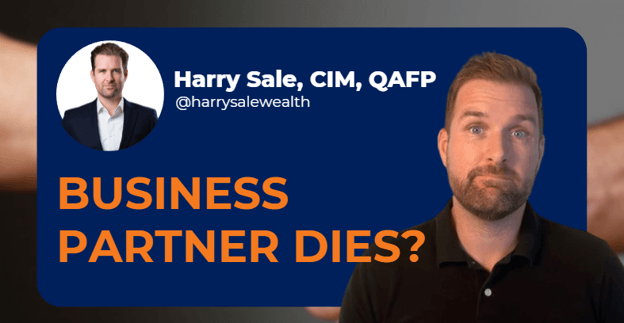
What Happens to My Corporation if Something Happens to Me?
Many business owners spend years building their business but very little time thinking about what happens if they die or become unable to work.
Important planning considerations often include:
- Wills
- Powers of attorney
- Shareholder agreements
- Buy-sell agreements
- Life insurance
- Business succession planning
These topics are easy to postpone because they don't feel urgent.
Unfortunately, they often become urgent when it's already too late to address them properly.
A good plan helps ensure your family, business partners, employees, and beneficiaries aren't forced to make difficult decisions during an already stressful time.
Here’s a video explainer to help with the details:
The Common Theme
Looking back at the questions I received this month, one theme stood out.
Most business owners weren't asking about investments.
They were asking about decisions.
- Should I create a holding company?
- How much cash belongs in my business?
- How should I invest retained earnings?
- Do I need an IPP?
- Am I on track for retirement?
- What happens if something happens to me?
Those aren't investment questions. They're financial planning questions, and they're often interconnected.
A decision about corporate cash can affect investment strategy. Investment strategy can affect retirement planning. Retirement planning can affect compensation decisions. Compensation decisions can affect tax planning.
The real value often comes from looking at all the pieces together rather than solving each issue independently.
Have a question you'd like answered? Email me directly at harry.sale@raymondjames.ca or book a meeting with me at https://calendly.com/harry-sale
© 2026 Raymond James Ltd. All rights reserved.
Privacy | Advisor Website Disclaimers | Manage Cookie Preferences
Raymond James Ltd. is an indirect wholly-owned subsidiary of Raymond James Financial, Inc., regulated by the Canadian Investment Regulatory Organization (CIRO) and is a member of the Canadian Investor Protection Fund (CIPF).
Securities-related products and services are offered through Raymond James Ltd.
Insurance products and services are offered through Raymond James Financial Planning Ltd, which is not a member of the Canadian Investor Protection Fund (CIPF).
Raymond James Ltd.’s trust services are offered by Solus Trust Company (“STC”). STC is an affiliate of Raymond James Ltd. and offers trust services across Canada. STC is not regulated by CIRO and is not a Member of the Canadian Investor Protection Fund (CIPF).
Raymond James advisors are not tax advisors and we recommend that clients seek independent advice from a professional advisor on tax-related matters. Statistics and factual data and other information are from sources RJL believes to be reliable, but their accuracy cannot be guaranteed.
Use of the Raymond James Ltd. website is governed by the Web Use Agreement | Client Concerns.
© 2025 Raymond James Ltd. All rights reserved. Member IIROC / CIPF | Privacy Policy | Web Use Agreement